A backgammon set is one of the few games where the box is the board. That makes the size on the listing the most important number you will read, and the least explained. “17 inches” usually describes the closed case, not the space you need on the table.
This is a researched equipment guide. We have not handled or tested the sets mentioned here. Dimensions and contents come from the sellers’ own listings, checked on September 9, 2026, and we show you the arithmetic so you can repeat it for any set you are considering.
What a complete set contains
The U.S. Backgammon Federation lists the standard equipment as 30 checkers, 15 in each color, two pairs of dice, dice cups and a doubling cube marked 2 to 64. Some inexpensive sets leave out the cube or ship a single pair of dice. Neither stops you from playing, but if you want to learn doubling later, look for the cube now.
| Item | Why it matters | What to check in the listing |
|---|---|---|
| 30 checkers | Every game uses all 30 | Count, diameter, thickness, material |
| Two pairs of dice | Each player rolls their own pair | “4 dice” means a full set; “2 dice” means sharing |
| Two dice cups | Fair rolls, fewer arguments | Included or sold separately; material |
| Doubling cube | Needed for match play and stakes | Present or absent |
| Board and case | Playing surface and storage in one | Closed and open dimensions, surface material |
What the inch figure means
Folding sets are named by the length of the closed case. Opened, the board is roughly twice as wide as the case and the same length. A 17-inch set therefore takes about 17 by 20 inches of table, before you add cups and elbows.
Two listings from the same importer show the pattern. Yellow Mountain Imports states its 15-inch “Pasadena” set closes to 15.2 × 9.4 × 1.8 inches. Its 17-inch “Cascadia” set closes to 17.3 × 9.8 × 2 inches and opens to 17.3 × 19.6 × 1 inches, with checkers of 1.2 inches diameter and 0.3 inches thickness. Cascadia specification
Use the open footprint, not the case, when you measure your table. A café-style table of 24 inches across fits a 15-inch set with cups beside it and a 17-inch set with cups on the ends.
Do the checkers fit the points?
Five checkers must stack along a single point during setup and often more during play. A quick check: multiply the checker diameter by five and compare it with half the open depth of the board.
| Cascadia, 17-inch | Figure |
|---|---|
| Checker diameter | 1.2 in |
| Five checkers in a row | 6.0 in |
| Open depth of the board | 19.6 in |
| Half the depth, one side’s points | 9.8 in |
Six inches of checkers on a point that is close to nine inches long leaves room. When a listing gives a checker diameter but no open depth, assume the open depth is about twice the closed width and run the same arithmetic. If five checkers would cover more than the point, the set will play cramped no matter how it looks in photographs.
This is a contents check from published numbers, not a statement about how the checkers feel, how they slide or how the board sounds. Those are handling questions, and we have not handled these sets.
Surface and materials
Listings describe playing surfaces as inlaid wood, veneer, leather, leatherette or felt, and checkers as wood, acrylic or resin. A listing rarely tells you how loud the checkers are on that surface or whether the points are printed or inlaid. Where the seller does not say, write “not specified” in your comparison rather than guessing from a photo. Both YMI sets above list acrylic checkers and wooden dice cups; neither listing names the wood species of the board, and one buyer’s question on the Cascadia page asks exactly that.
Three sizes, three tables
| Closed length | Typical use | Trade-off |
|---|---|---|
| Under 12 in | Travel and magnetic sets | Small checkers, stacks that spill in a moving car |
| 15 in | A small shared table, a shelf, a bag | Checkers around an inch; comfortable for two, tight with cups |
| 17 to 19 in and above | A dining table or a dedicated game table | More room for the hand and the cube; needs storage space closed |
The middle row is where most first sets land. If you play at a small table, the 15-inch class keeps the cups on the table. If you have a full table and want the checkers easy to pick up, the 17-inch class is the sensible minimum.
Two sets we list, and why
These are the two sets shown in our playroom. They were selected by listed size and contents so that a 15-inch and a 17-inch option sit side by side. We have not tested them and do not rank them.
15-inch folding set · smaller tables
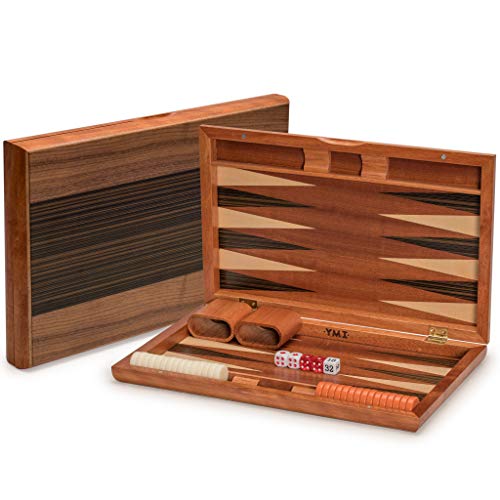
Listed contents: 30 acrylic checkers, four dice, doubling cube, two wooden dice cups. Closed case 15.2 × 9.4 × 1.8 inches. Playing surface is wood, not padded.
17-inch folding set · a little more room

Listed contents: 30 acrylic checkers of 1.2 inches, four dice, doubling cube, two wooden dice cups. Open board 17.3 × 19.6 inches.
Check the selected version, current offer and contents on Amazon before ordering. Listings change; our figures are from September 9, 2026.
A checklist for comparing two listings
- Closed and open dimensions: both, in the same unit. If only closed is given, estimate open as twice the closed width.
- Checker diameter and count: 30 checkers, and five diameters against half the open depth.
- Dice and cups: four dice and two cups for a complete set.
- Doubling cube: present, if you plan to learn doubling.
- Surface and materials: as stated by the seller; “not specified” where silent.
- Storage: does the case hold the checkers securely, or do they need a bag?
- Table: measure yours before you decide between 15 and 17 inches.
Rules before equipment, as always. If you are still learning how the checkers move, our setup and rules guide takes you from the first roll to bearing off, and the free game lets you try it before a set arrives.
Sources
- Beginner’s Guide to Backgammon, U.S. Backgammon Federation: standard equipment.
- Yellow Mountain Imports, Cascadia 17-inch: dimensions, checker size, contents. Pasadena dimensions from the Amazon listing as supplied through our product integration on September 9, 2026.