Before choosing colors, a carrying case or a price range, ask the people you plan to play with one question: Which version of mahjong do you play? The answer determines which tiles and rules you need.
An American mahjong set, a set for a Chinese variant and a Japanese riichi set are not interchangeable without checking their contents. A larger number on the box does not automatically make a set more suitable.
This is a researched equipment guide. We have not handled or tested the sets mentioned here. Product contents are seller specifications, not Tabletop Wire measurements.
Start with the table you want to join
| Your group plays… | What to establish before buying |
|---|---|
| American mahjong using National Mah Jongg League rules | An appropriate American tile set, including jokers, and the card edition used by the group |
| A Chinese mahjong variant | The exact ruleset and whether it uses flower or season tiles; “Chinese mahjong” alone is not a complete rules specification |
| Japanese riichi | A suitable riichi tile set and the group’s rules on red fives and scoring equipment |
| You do not know yet | Ask the teacher or host for the ruleset name and a photograph of their tiles before ordering |
The National Mah Jongg League publishes an annual card; confirm the year your group uses. Confirm that a listing includes the card you need rather than assuming a rules booklet serves the same purpose. National Mah Jongg League
Why American sets can say 152, 160 or 166 tiles
For American play, distinguish the tiles used in the game from everything supplied in the box. The Mahjong Line’s field guide identifies 152 playing tiles, while its featured set contains 160 because it also supplies extra jokers and blanks. Those extras do not mean you put every tile into play. Manufacturer’s field guide
Here is a second example, checked against a seller’s itemized contents on September 9, 2026:
| Yellow Mountain Imports “The Classic,” item US-AT007-A | Tiles listed |
|---|---|
| Circles, bamboos and characters | 108 |
| Winds | 16 |
| Dragons | 12 |
| Flowers | 16 |
| Jokers | 10 |
| Blank spares | 4 |
| Total supplied | 166 |
Our arithmetic separates that inventory into a 152-tile American playing selection—108 suited tiles, 28 winds and dragons, eight flowers and eight jokers—and 14 additional tiles. This is a contents check, not a quality rating. The same listing explicitly excludes racks and other accessories. A box can therefore contain more tiles than you need and still leave you with equipment to obtain separately. Seller’s itemized specification
Chinese and riichi sets: identify the rules first
A common Chinese set contains 144 tiles, including eight flower and season tiles. That count describes equipment; it does not establish one universal set of Chinese rules. Ask which variant your group actually plays. Shanghai’s introduction to mahjong
The 2022 World Riichi Championship rules specify 136 tiles. They also exclude red fives, illustrating why even “riichi” needs a rules check: do not assume every table uses every optional tile supplied with a set. World Riichi Championship rules, 2022
A set without the necessary jokers is not ready for standard American play simply because its suits look familiar. Conversely, extra jokers in an American box are not a reason to add jokers to another variant.
Do you need a mahjong table?
You do not need a dedicated mahjong table to begin. You need a flat surface large enough for four walls, four players and, for American play, four racks. Three options, in rising order of cost:
| Option | What it gives you | What to check |
|---|---|---|
| A suitable table plus a mat | A mat can reduce tile noise and sliding; use a table that fits your group’s setup. | Measure the tabletop against four walls and the central discard area. Wall lengths depend on the ruleset and tile size; racks add space along each edge for American play. |
| A folding mahjong table | A dedicated square top, usually with a raised edge and sometimes drawers or cup holders, that stores flat. | Listed top dimensions, height, and whether racks fit inside the raised edge. Weight if it will move between rooms. |
| An automatic table | Shuffles and builds the walls for you between hands, using its own matched tile sets. | A different purchase class: it replaces the set rather than adding to it, needs power and space, and its tiles are not interchangeable with a boxed set. We have not used one and do not cover them here. |
Before choosing a table, establish the tile and rack dimensions. They determine the room needed for walls and each player’s area. Listing dimensions are inputs for that check, not our measurement of a complete setup.
Racks and pushers: check the bundle
American mahjong is played with tile racks, and groups may also use pushers, the bars that slide a wall forward. Some American sets bundle them and some do not. Yellow Mountain Imports’ “Heather” American set lists four wooden racks with pushers in the box, while the same importer’s “The Classic” itemization explicitly excludes racks. Heather listing
For Chinese variants and riichi, racks are not part of standard play; tiles stand on their edges in front of you. If a listing for a Chinese set advertises racks, treat it as a bonus, not a requirement.
Two listed sets: match the variant first
These are the same source-selected sets shown in our playroom. They are examples of different inventories, not a tested ranking. The American set is not a substitute for a Chinese or Riichi set; check the exact offer before ordering.
Affiliate disclosure: As an Amazon Associate, Tabletop Wire earns from qualifying purchases. Links in the product cards go to Amazon.com. Read our commercial-link policy.
American Mahjong: Heather set
The listed bundle includes 166 tiles and four wooden racks with pushers. For NMJL play, obtain the annual card used by your group; it is not included. We have not handled these tiles or tested the bundle.
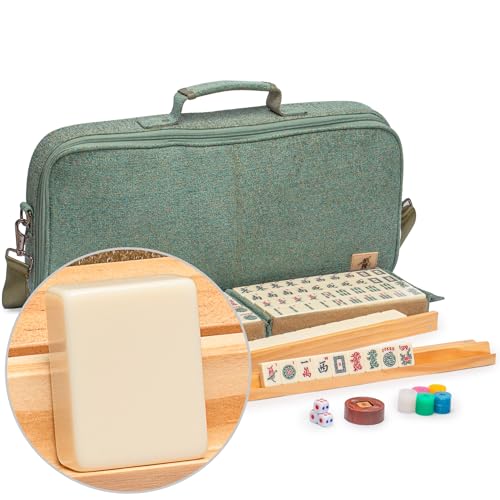
Check the selected variant, inventory and current contents against the manufacturer’s Heather specification.
Chinese Mahjong: 146-tile set
The listed inventory is 144 playing tiles plus two blank spares. It has no jokers or added Arabic numbers/letters; racks and pushers are not included. Check whether the markings and bonus tiles match your named ruleset. This is not an American Mahjong set.
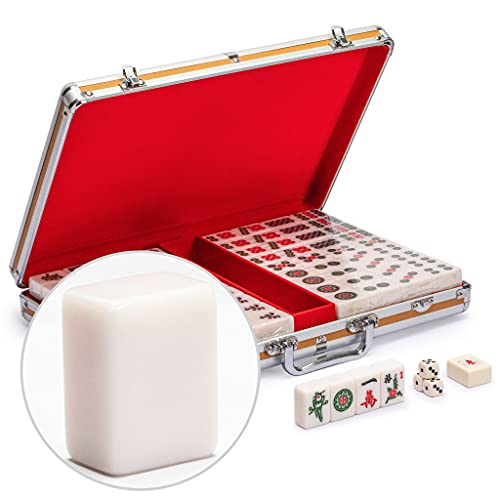
Verify the chosen listing and included pieces. A decorative description alone does not establish compatibility with your group’s rules.
Selection is based on listed contents and variant compatibility, not physical tests. Seller claims and availability can change. How we work.
A checklist for comparing two listings
Once the rules match, write down these details side by side:
- Tile inventory: the individual categories and quantities, not just the headline total.
- Tile dimensions: use the stated measurements to judge size; photographs alone can be misleading.
- Markings: inspect how numbers, winds and dragons are identified. Ask whether everyone at your table can distinguish them easily.
- Accessories: list racks, pushers, dice, scoring equipment and carrying case separately. Record “not specified” where the seller is silent. American play expects racks; Chinese and riichi play does not.
- Table space: the tile dimensions tell you how long four walls will be; add rack length along each edge for American play before deciding whether your table is big enough.
- Rules material: check the named variant and, where relevant, the card year.
- Replacement route: ask whether matching replacement tiles are available before treating spare blanks as a complete solution.
- Full cost: add any equipment your group needs that the listing excludes.
For example, the Yellow Mountain Imports listing gives tile dimensions of 30 × 23 × 13 mm. That is a useful comparison input, but it does not tell us how those tiles feel, how easily they stand or how readable they are across your table. Those questions need handling and play, not a specification sheet.
Buying for two people?
Do not assume a mahjong set is a dedicated two-player game. Establish the particular two-player adaptation you intend to use before buying equipment for it. For a first session with a group, matching that group’s rules is the more useful starting point than buying the most elaborate set.
Choose the rules, check the inventory, then choose the design. That order helps you bring the right equipment to the table.
Looking for the tile-matching puzzle instead?
Play our free Mahjong Solitaire game for a solo puzzle with hints, undo and a daily deal. It uses mahjong-inspired tiles, but it does not teach the rules of multiplayer mahjong. For that distinction, start with our guide to mahjong rule variants.